 Bloom
BloomBest Private Period Tracker App: What to Look For
A period tracker asks for some of the most sensitive information you'll ever put into an app — dates, symptoms, sexual activity, sometimes pregnancy status. Most people pick one based on the calendar UI and never look at what happens to that data afterward. That's the wrong way round.
This is a practical checklist for judging how private a period tracker actually is, not just how private it claims to be.
Why this matters more than it used to
Period and fertility data is health data, and health data is valuable — to advertisers building profiles, to data brokers, and in some jurisdictions, potentially to third parties with a legal interest in reproductive history. An app doesn't need to be malicious to create risk here; it just needs to store your data somewhere it can be requested, subpoenaed, breached or sold on.
The checklist
1. Does it require an account?
An account means your cycle data is tied to an identity — an email address, sometimes a phone number — on a server somewhere. If an app works perfectly well with no sign-up at all, that's a strong signal your data isn't being centralized anywhere.
2. Is your data stored on your device, or in the cloud?
Cloud sync is convenient, but it means a copy of your cycle history exists on a server you don't control, governed by a privacy policy that can change. An app that works fully offline, with data encrypted and stored only on your phone, removes this risk by design — there's no server copy to protect, breach or hand over.
3. What does the privacy policy actually say about sharing?
Skip to the "how we share your information" section. Look specifically for phrases like "aggregated data," "analytics partners" or "advertising partners" — these are the mechanisms by which supposedly de-identified health data ends up shared with third parties. A short, plain-language privacy policy with no sharing section is a good sign; a long one full of exceptions is not.
4. What permissions does it ask for?
A period tracker doesn't need your contacts, precise location history, or advertising identifier to predict a cycle. If the permission list looks more like a social app than a health app, that's worth questioning.
5. Can you actually use the core features without agreeing to anything extra?
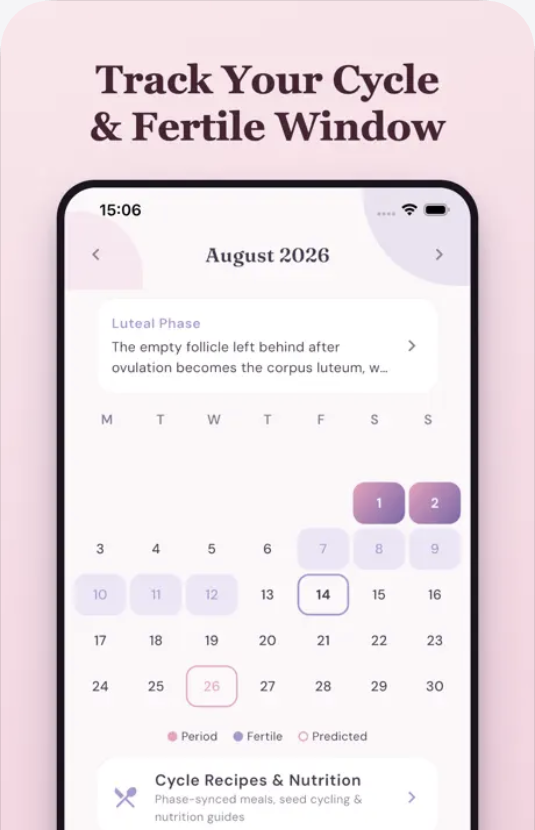
Some apps gate basic tracking behind account creation or a marketing opt-in. Bloom is built the other way: install it and start tracking your cycle, fertile window or pregnancy immediately, with no account and no data ever leaving your device.
Track your cycle without an account
Bloom works fully offline, with every entry encrypted on your device — no sign-up, nothing shared. Free on the App Store.
Download on theApp StoreA quick self-audit for the app you use today
Open your current period tracker's settings and privacy policy and ask three questions: Does it work with airplane mode on? Did it ask for an account before you could log anything? Does its privacy policy mention "partners" or "advertising" in the sharing section? If you answered no, yes and yes, your data is probably leaving your phone in ways you haven't seen. For more on how this actually happens in practice, see our guide on whether your period tracker is selling your data.
FAQ
Is an offline app less accurate than a cloud-based one?
No. Cycle and fertile window predictions are calculated from the dates and symptoms you log, not from cloud processing power. An offline app predicts just as accurately — it simply does the calculation on your device instead of a server.
If there's no account, how do I get my data on a new phone?
Look for an app with a local export feature — a PDF or file you can save and transfer yourself, rather than an account-based cloud restore. That keeps the "you control the copy" principle intact even when switching devices.
Are free period trackers automatically less private?
Not automatically, but it's worth checking how a free app is funded. If there's no subscription and no ads, look at whether the privacy policy mentions data sharing with analytics or advertising partners — that's often how "free" is paid for.
This guide is general wellness and privacy information, not medical or legal advice.