 OnChain
How to Track Crypto Whale Wallets in Real Time
When a wallet holding nine figures of crypto starts buying, the price usually hasn't reacted yet. When it starts sending coins to an exchange, a dump may be minutes away. That's why traders track whale wallets — the small number of addresses whose moves are big enough to move markets.
This guide explains what whale wallets are, how to find them, how to read their transactions, and how to get whale activity delivered to your phone in real time instead of monitoring a block explorer all day.
What is a crypto whale wallet?
A whale is any address that holds enough of an asset to influence its price — typically thousands of BTC or ETH, or a large share of a smaller token's supply. Whales include early adopters, funds, market makers, exchanges and project treasuries. Because every blockchain transaction is public, anyone can watch what these wallets do — the challenge is doing it fast enough to matter.
Why whale moves front-run price
- Exchange inflows — a whale depositing a large amount to an exchange often intends to sell. Big inflows are a classic bearish tell.
- Exchange outflows — coins moving off exchanges into private wallets suggest long-term holding: supply leaving the market.
- Accumulation — repeated buys of the same token across days or weeks signal conviction before public attention arrives.
- Distribution — a wallet steadily trimming a position while price rises is quietly exiting into strength.
None of these is a guarantee — whales sometimes shuffle funds between their own wallets or move via OTC desks precisely to mislead watchers. But taken together, whale flow is one of the earliest signals available to a retail trader.
How to track whale wallets: step by step
1. Watch the large-transaction feed
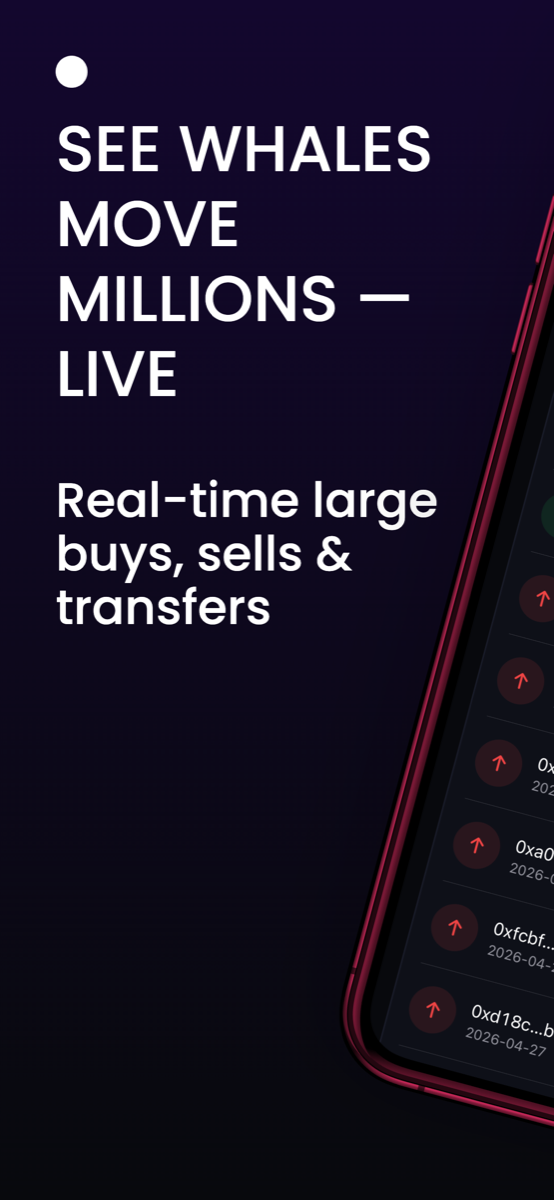
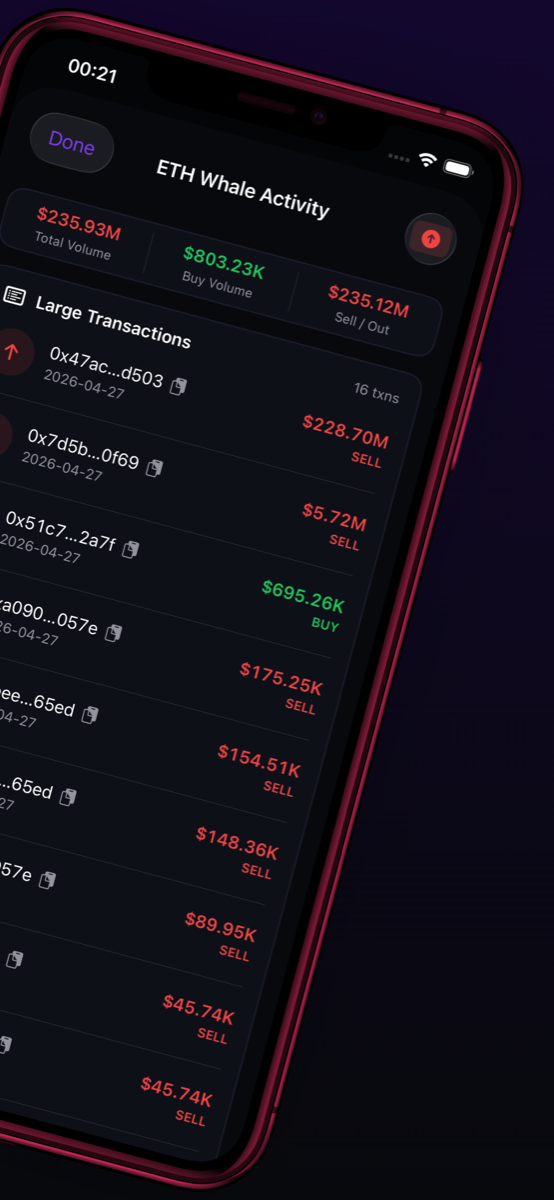
The fastest way to find whales is to watch large transactions as they happen. OnChain: Crypto Tracker streams real-time large buys, sells and transfers across Ethereum, Bitcoin, Solana, BNB Chain and Polygon — with buy/sell volume totals per chain so you can read net pressure at a glance.
2. Identify wallets worth following
A single big transaction means little; a wallet with a history of profitable entries means a lot. OnChain's smart-money leaderboard ranks top wallets by win rate, so instead of guessing which whales are smart, you follow the ones with receipts. (More on this in our smart money guide.)
3. X-ray the wallet before you trust it
Paste any address into OnChain to see its full portfolio: total value, every holding, and whether it's currently accumulating or distributing. A "whale buy" from a wallet that's also dumping three other tokens tells a different story than one from a disciplined accumulator. (See: wallet address lookup guide.)
4. Read the context, not just the transaction
Cross-check whale flow against sentiment and momentum. OnChain scores every coin 0–100 by combining whale activity, social sentiment and chart signals — with a plain-English explanation. Whale buying + improving sentiment + firming momentum is a much stronger setup than any single signal alone.
5. Let alerts do the watching
You can't stare at a feed all day. Set price alerts on your watchlist and let real-time whale tracking surface the big moves — your phone buzzes when it matters.
Common mistakes when tracking whales
- Blindly copying every large trade. Exchanges and market makers move huge sums for operational reasons that have nothing to do with direction.
- Reacting to a single transfer. Look for repeated behavior — accumulation patterns, not one-off transactions.
- Ignoring token risk. Whales get airdropped junk too. Before buying what a whale holds, check the token's contract for risk.
- Being late. Twitter whale-alert accounts post minutes after the fact. By then the move is priced in. Real-time on-chain feeds close that gap.
Track whales from your pocket
OnChain streams whale buys, sells and transfers in real time — plus a smart-money leaderboard and wallet x-ray — for $5.99/month. Live prices and alerts are free forever.
Download on theApp StoreFAQ
How much crypto makes a wallet a "whale"?
There's no official threshold. Common shorthand: 1,000+ BTC or 10,000+ ETH, or any wallet holding over ~1% of a token's supply. What matters is whether the wallet's trades are large enough to move the market it trades in.
Is whale tracking legal?
Yes. Blockchains are public ledgers; reading them is exactly what they were designed for.
Can whales hide their activity?
Partially — through OTC trades, mixers or splitting across many wallets. That's why whale flow should be one input among several, alongside sentiment and momentum, not a standalone trading system.
Crypto markets are volatile. This guide is information, not financial advice. Always do your own research.