 Bloom
BloomHow to Track Your Fertile Window Accurately
The fertile window is the span of days in a cycle when pregnancy is possible — and it's shorter, and less centered on "day 14," than most people assume. Getting it right (or wrong) matters whether you're tracking to conceive or to avoid it.
What the fertile window actually is
An egg survives roughly 12–24 hours after ovulation, but sperm can survive in the reproductive tract for up to five days. That combination is what creates the fertile window: typically the five days before ovulation plus the day of ovulation itself — about six days total, not a single day.
The common shorthand of "ovulation on day 14" assumes a perfect 28-day cycle. Cycle length varies a lot between people, and even cycle to cycle for the same person, which is why a fixed-day rule is unreliable on its own.
Methods used to estimate it
Calendar / cycle-length method
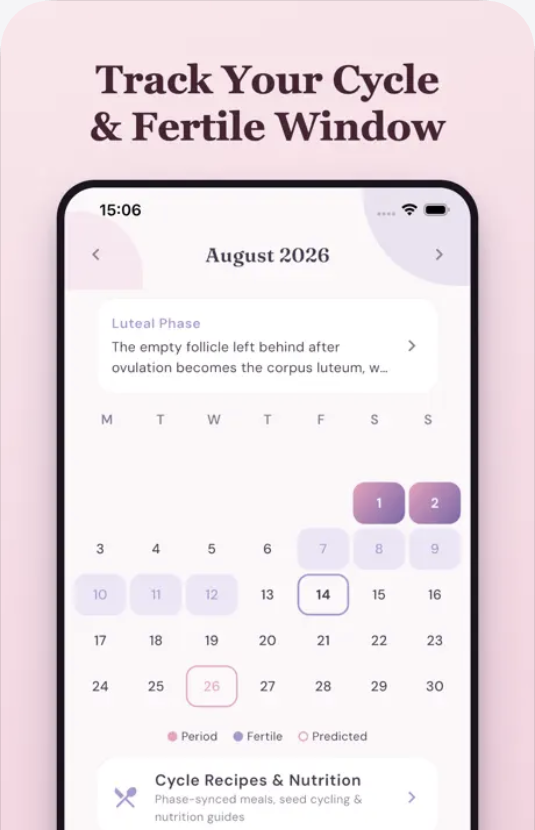
Estimates ovulation based on the average length of your recent cycles, counting backward roughly 14 days from the expected start of your next period (the luteal phase — after ovulation — is relatively consistent in length, even when the first half of the cycle varies). This is what most tracking apps, including Bloom, use as a baseline.
Symptom tracking
Physical signs — changes in cervical mucus, mild ovulation pain, breast tenderness — can supplement the calendar estimate. None of these are precise alone, but logged consistently over a few cycles, they help refine when your body's pattern actually falls relative to the calendar estimate.
Basal body temperature (BBT)
Body temperature rises slightly after ovulation has already happened, due to progesterone. This confirms ovulation occurred, but after the fact — useful for understanding your pattern over time, not for predicting the fertile window in the current cycle.
Ovulation predictor kits (OPKs)
Test for the luteinizing hormone (LH) surge that precedes ovulation by roughly 24–36 hours. These give a more immediate signal than calendar estimates alone, and can be combined with tracked cycle history for a fuller picture.
Common mistakes that throw off predictions
- Assuming a fixed 28-day cycle. Cycle length regularly ranges from 21 to 35 days between individuals — using your own tracked average is far more accurate than a generic default.
- Only logging period start dates. The more consistently you log full cycles (not just the days you bleed), the better a calendar-based estimate gets over time.
- Ignoring cycle-to-cycle variation. Even a single irregular cycle — from stress, illness or travel — can shift that month's ovulation earlier or later than your average predicts.
- Treating the fertile window as one single day. Because sperm survive several days, the fertile window starts well before ovulation itself, not on ovulation day alone.
Fertile window predictions, tracked privately
Bloom predicts your fertile window from your logged cycle history — fully offline, encrypted on your device, no account needed. Free on the App Store.
Download on theApp StoreWhy the data behind this prediction should stay private
Fertile window and conception tracking is about as sensitive as health data gets. Whatever app you use for it, it's worth applying the same scrutiny covered in our private period tracker checklist — account requirements, cloud sync, and what the privacy policy actually permits.
FAQ
How many cycles of data does a prediction need to be useful?
Predictions improve with each logged cycle, but even 2–3 cycles of consistent tracking gives a meaningfully better estimate than a single generic default. Accuracy keeps improving the longer you track.
Can irregular cycles still be tracked accurately?
Estimates are naturally less precise with irregular cycles, since they rely partly on your recent average. Combining calendar tracking with a symptom-based method (like cervical mucus changes) tends to help most when cycles vary.
Is fertile window tracking a reliable form of contraception on its own?
Used alone, calendar-based fertility awareness carries a meaningfully higher failure rate than most dedicated contraceptive methods, particularly with irregular cycles. If you're relying on tracking specifically to avoid pregnancy, it's worth discussing the method and its real-world effectiveness with a healthcare provider.
This guide is general information, not medical advice. Consult a healthcare provider for guidance specific to conception or contraception.