 Bloom
BloomPregnancy Week by Week: What to Expect Each Trimester
Pregnancy is usually counted in weeks from the first day of your last period, not from conception — which is why "week 4" often means only about two weeks since conception actually happened. That single fact trips up a lot of first-time trackers, so it's worth starting there.
Below is a trimester-by-trimester overview of what's generally happening and what's useful to track at each stage.
First trimester (weeks 1–12)
This is when the earliest and often most noticeable symptoms appear — fatigue, nausea, breast tenderness, and a missed period as the first sign for many. Internally, this is the period of most rapid structural development: the neural tube, heart and major organs all begin forming.
Worth tracking: symptoms and their severity (useful context for early appointments), estimated due date, and any spotting or pain worth mentioning to a doctor.
Second trimester (weeks 13–27)
Often called the more comfortable stretch — early nausea typically eases, and energy levels tend to recover. Around the middle of this trimester, many people start to feel movement for the first time. Anatomy scans usually happen here too.
Worth tracking: when movement starts and its pattern, weight and symptom changes, and questions building up for your next appointment.
Third trimester (weeks 28–40+)
Growth accelerates and the body prepares for labor. Symptoms like back pain, shortness of breath and Braxton Hicks contractions become more common as space gets tighter. Appointments typically become more frequent in these final weeks.
Worth tracking: contraction patterns as you approach your due date, hospital-bag and birth-plan notes, and any symptoms your care provider has asked you to flag.
Why week-by-week tracking helps, beyond curiosity
- Context for appointments. A running log of symptoms and dates makes it easier to answer "when did this start?" accurately instead of estimating on the spot.
- Spotting patterns early. Tracking makes it easier to notice when something changes from your own baseline, not just against a generic average.
- A record worth keeping private. Pregnancy tracking data is sensitive by nature — how privately it's stored is worth the same scrutiny as any other health app.
Week-by-week guidance, fully offline
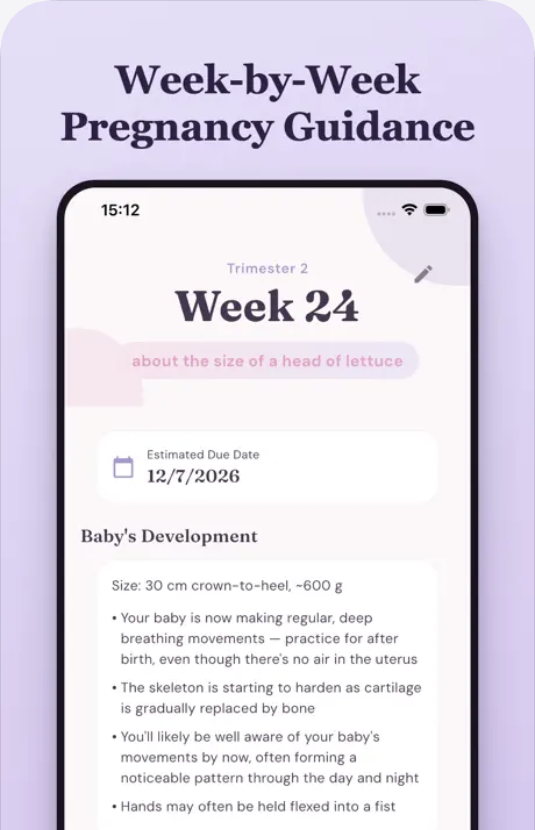
Bloom's pregnancy mode covers trimester, due date and development notes for every week — encrypted on your device, with no account required. Free on the App Store.
Download on theApp StoreFAQ
Why does pregnancy start counting before conception?
Because the exact moment of conception is rarely known, but the start of the last period usually is. Counting from that date gives a consistent, easily identifiable reference point, even though it means "week 4" is closer to two weeks post-conception.
How accurate is an app-estimated due date?
App estimates based on your last period are a reasonable starting point, but an ultrasound-confirmed due date from a healthcare provider is more precise, especially if your cycle is irregular. Use the app estimate as a guide, not a replacement for a clinical one.
Can I switch back to cycle tracking after pregnancy?
In Bloom, yes — the app is built to move between cycle-tracking mode and pregnancy mode, so your history carries through rather than starting over.
This guide is general information, not medical advice. Always follow the guidance of your own doctor or midwife.