 OnChain
Crypto Wallet Address Lookup: See Inside Any Wallet
Every crypto wallet is an open book. Blockchains are public ledgers, which means any address on Ethereum, Bitcoin, BNB Chain or Polygon can be inspected by anyone — its full holdings, its history, its behavior. The question isn't whether you can look inside a wallet; it's how to do it without wrestling raw block-explorer data.
Why look up a wallet address?
- Scout a whale. You saw a large buy in a whale feed — is that wallet a disciplined accumulator or a serial dumper?
- Vet smart money. Before following a wallet from a smart-money leaderboard, check what it actually holds.
- Check a project's team wallets. If the treasury or dev wallets are quietly distributing, believe the wallets, not the roadmap.
- Verify before sending. Confirm an address is live and holds what a counterparty claims.
- Watch your own cold wallet — read-only, without ever connecting it to anything.
How to look up any wallet on iPhone
- Open OnChain: Crypto Tracker (free, no account needed).
- Paste the wallet address into the Portfolio lookup and pick the chain — ETH, BTC, BSC or Polygon.
- Tap Load.
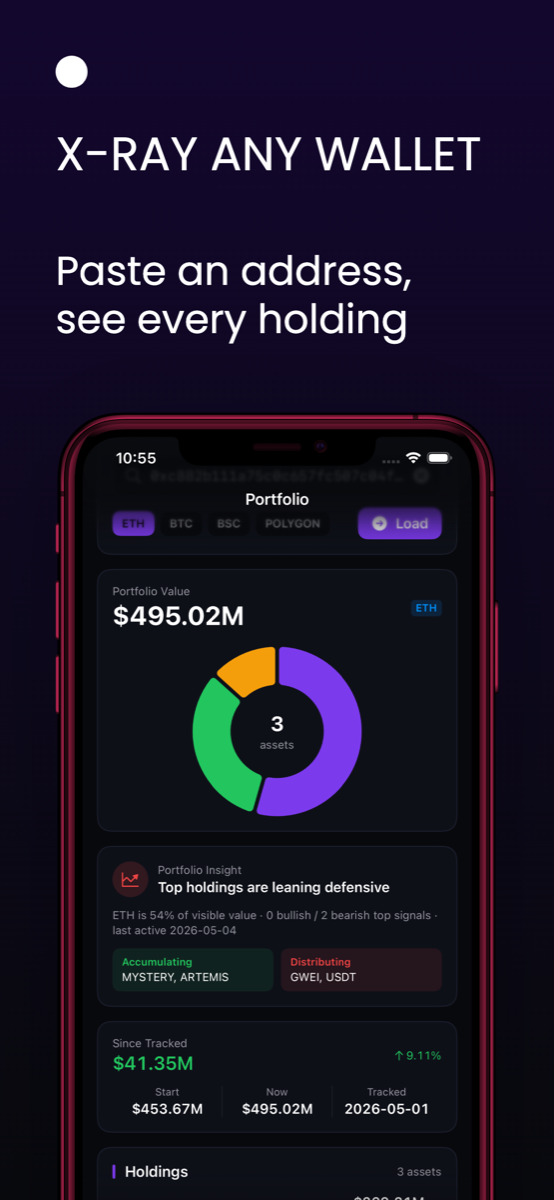
You'll see the wallet x-rayed:
- Total portfolio value and an asset-allocation breakdown,
- Every holding, with live prices,
- Portfolio insight — whether top holdings lean bullish or defensive,
- Accumulating vs distributing — which tokens the wallet is adding and which it's exiting,
- Value since tracked — how the portfolio has performed since you started watching.
How to read what you find
Accumulation vs distribution
A wallet steadily adding to a position across weeks is expressing conviction. A wallet trickling a position out while price rises is exiting into strength. When several large wallets show the same pattern on the same token, that's flow — the signal whale watchers trade on.
Concentration
For token research: if the top few wallets hold most of the supply, they control the price. Pair a wallet lookup with a contract risk check before buying anything they could dump.
Dormancy and reactivation
Old wallets waking up after years is a classic market-moving event. If an address you track suddenly becomes active, you want a notification, not a surprise.
Is wallet lookup private and safe?
Yes — it's read-only. You're viewing public ledger data. OnChain never asks you to connect a wallet, sign anything or share keys. Addresses are pseudonymous: you see what a wallet does, not who owns it, unless the owner has linked their identity publicly.
X-ray your first wallet in 30 seconds
Wallet lookup is free in OnChain — no account required. Advanced wallet profiles (accumulation, distribution, activity patterns) come with Pro.
Download on theApp StoreFAQ
Can I see who owns a wallet address?
Not directly — addresses are pseudonymous. But behavior (exchange patterns, funding sources, timing) often reveals whether it's an exchange, a fund or an individual.
Can someone track my wallet the same way?
Yes. Anything you do on a public chain is visible to everyone. That transparency is exactly what makes whale and smart-money tracking possible.
Which chains does OnChain's wallet lookup support?
Ethereum, Bitcoin, BNB Chain (BSC) and Polygon, with live pricing across thousands of tokens.
Crypto markets are volatile. This guide is information, not financial advice. Always do your own research.